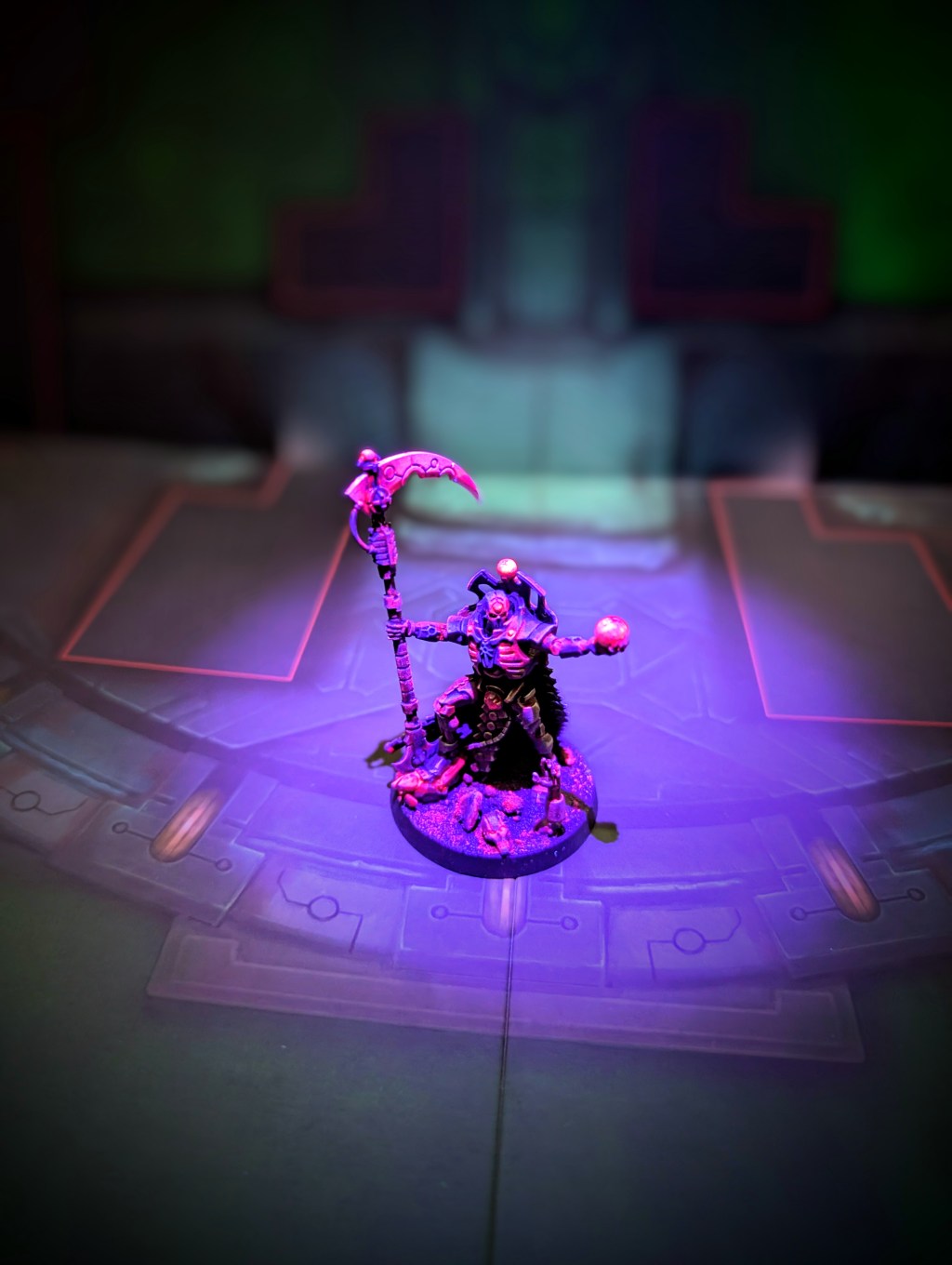

Nobody was enjoying the party.
Most of the assembled Necron courtiers would much rather have been on the planet below, especially as they were so close to their goal. However, even in a second-rate dynasty such as the Shakhana, protocol must be followed and a full ceremony to formally greet the Triarch Praetorians was due. In truth, there was little for any of them to do on the surface at present anyway. The site around the Tower of Murmuration had been secured, for now, and a legion of warriors were busy digging, trying to find their way into the labyrinth beneath.
Traditionally, the ceremony would have taken the form of a great feast in multiple courses, interspersed by performances and sermons glorifying the Star Gods. The Necrons no longer ate, and had cast down their gods. Instead, as master of ceremonies, Klotophis had selected the shortest possible schedule of entertainments that would satisfy propriety, concluding with a short section of an aria from The War In Heaven.
The performers, aware of their betters’ impatience, rushed through at a greatly accelerated tempo and managed to complete the song in a record fourteen hours.
The audience sat silent and still as statues throughout the entire performance. Only as the singer entered into the last few bars did they begin to stir. Those that had pushed their chronosense to its limit trying to get through the evening as quickly as possible started shifting back down to Necron standard time. Barrakhad in particular started fidgeting, flexing his claws, eager to get back to killing.
As the final notes died away Farreskh sprang from her throne and stepped swiftly onto the dias.
“My beloved, lords and ladies, if I might crave your indulgence a while longer, I have one final item to add to the programme!” She announced.
There were groans from some, polite murmuring from those who realised it was a better idea to keep on Her Majesty’s good side.
She extended an arm towards Barrakhad. “My Lord. My love. I have a gift for you.”
She began to dance.

She had been a bookish young woman when alive, with no great love for dancing. But it had been an expected part of her education and she had dutifully learned. On biotransference those lessons had been digitised, neatly filed away in her memory banks and now she could reproduce the movements easily and effortlessly, moving with a power and a perfect mechanical grace her frail mortal body could never have matched.
She began her dance without music, but the accompaniment kicked in as her Lychguard led the first of the human prisoners onto the stage. Their sobs and wails were discordant, but a raw material from which a song might be constructed if only a rhythm could be imposed.
Her Voidscythe materialised in her hand.
The song grew to a chorus of synchronised screams as, at the climax of one balletic sweep, the very tip of the scytheblade opened an artery in the first slave’s neck.
The fountain of blood was sudden and shockingly powerful, splashing across her faceplate and torso. The scythe traced a figure eight, each sweep slicing another vital point and adding a fresh jet to the spray. Soon all pressure was lost and the flow died down to a trickle. The spent body was dragged away by the Lychguard and the next human thrall brought forwards.
The screams kept to the tempo of her swings the first few times, but rapidly devolved into an inchoate mass of noise, the true beat a hidden, subtle thing on the edge of understanding. The humans strained against their captors, but inflexible metal hands clamped down on them tightly and permitted no movement or escape, forcing them inexorably forwards, one by one.
Blood coated Farreskh, ran off and down inside her plating. The fizzing Voidblade drew contrails of roiling red vapour behind it, every motion of her limbs flicked fresh arcs into the air that became part of the dance. A constantly shifting, rising and falling mandala pattern of spinning gore.
The performance lasted for one hundred human lives, and was over in minutes.
As the final note fell silent, Farreskh spun into an ending pose and held it, dripping. She raised her eyes to the audience and found there a mixture of fascination and disgust – the latter most clearly etched on the faces of the Triarch Praetorians looking down from their place as honoured guests.
She looked instead to Barrakhad. His eyes, which had burned dim throughout the previous performance, now blazed down into hers. Finally, she had his attention.
“Beloved, I wonder if you might grant me an audience in private?” Farreskh asked.
***
“Bringing the unclean here was inefficient. You could have killed them on the surface.” Barrakhad said.
They walked in the galleries, alone except for a wave of Scarabs that preceded them, scouring any dirt from the path before royal oculars could perceive it. A second, smaller, wave followed behind and cleaned up the trail of blood left in Farreskh’s footsteps.
“Beloved, with all respect, you command weaponry that could scour this whole system of life in seconds. Yet you prefer to run around hacking things up with blades. I think there is more to this Destroyer philosophy of yours than pure efficiency.”
Barrakhad chuckled, the sound like sliding tombstones. “You have a point.”
“Did you not like your gift, my love?”
“I… did. It was a most impressive display. Merely… inefficient.”
“Perhaps, but these are the lengths I must go to, just to have a conversation with my husband, it seems.”
Barrakhad slumped slightly, the grinding of ancient pistons something like a sigh. “I… apologise. I have been neglecting you. I have been… distracted.”
She placed one hand on his colossal shoulderguard, leaving a red smear. “I am sorry also. That is why I wished to talk to you. I wanted to apologise for calling the Praetorians here. I did not wish to offend you, just…”
Barrakhad waved a great clawed hand, as if offense was a concept far beneath him. “You did what you thought right, I’m sure. But… I am not insane. I am just… exactly what your kind always thought I was. Nothing more than a killer.”
“‘My kind’? You do me wrong, my Lord. I know you are more than that.”
“Once, perhaps. No longer.”
“But you must be more than that, my Lord. You are Phaeron. You have duties that you neglect…”
Barrakhad snarled suddenly, rounded on her. “I took on those duties for a lifetime! Not for this… endless eternity! And I will not take lessons on duty from you, who has neglected her own!”
“My duty? I don’t know what you mean…”
“The child.”
“A child?” Farreskh’s own anger finally broke through her iron-clad restraint. “Is that what this is really all about – that while living I failed to produce the heir you were so desperate for?” She indicated the metal skeletons that were now their bodies. “I don’t think there’s much point holding on to that anymore, is there?!”
Barrakhad was silent for a moment. “You don’t remember?”
“Remember? I don’t…”
“Come.”
He lead her upwards, towards the royal chambers at the top of the ship. The ones that something deep inside had told her to avoid. Her feet felt heavier with each step.
“I don’t… want…”
“Come.” He repeated. His great clawed hand was on her shoulder, guiding her on.
A memory came back to her. Her last as a living Necrontyr. Another metal hand on her shoulder, pushing her on into the biofurnaces. She remembered stumbling, but managing to keep hold of the precious thing she carried in her arms.
“No.” She cried. “No!”
His grip tightened. She struggled, but even with the strength of her Overlord’s body she could not resist the incredible power of the Destroyer Lord’s optimised form, nor the command protocols that lashed her systems at the mere thought of disobedience.
“Beloved.” He said, his voice as gentle as it could be. “You must see.”
They reached the royal gardens. When she had last been here, this had been a verdant green refuge amongst the sepulchural gloom of the rest of the ship. The top of the domed chamber featured a portal to the orbit of a distant star that bathed the garden in natural sunlight no matter where the Reaper of Eternity might be. Now, the planters were all empty, the trees and flowers long since turned to dust. Sixty million years of stellar drift had left the portal out of alignment. It showed only the dark, cold depths of interstellar space.
Farreskh no longer struggled quite so fiercely. The new struggle that occupied her was mental. It was as if there was a door in her mind she was desperately trying to hold shut, against something on the other side that was beating against it with ever-increasing strength.
L
Another memory slipped out – this one a few months after the first and in this very chamber. She saw Biomancer Yetop, the Royal Physician, kneeling before her, begging for mercy.
“I am sorry, My Lady, there is nothing more I can do! I have tried everything I can think of, but… I am a healer of flesh… these metal bodies… my skills are useless here, and even if they were not… I see no way the process can be reversed!”
Farreskh’s hands had been about her throat, trying to close a windpipe that no longer existed. Instead she tore into the Biomancer’s body, ripping metal like paper in her rage, crushing internal components in balled fists. While her hands demolished the Cryptek physically her mind unleashed an interstitial data-wave of pure anger that washed over Yetop’s personality core like a nuclear blastwave, burning away her engrams, unmaking connections, denying reanimation protocols with a noble’s override.
Yetop had pleaded, then screamed, then at last been silent. An empty thing of twisted metal in her hands. She hadn’t thought about doing it. She hadn’t even known she could do it. It had been… so easy, in this new body.
Why? Why had she done that? What had caused the all-consuming rage that had filled her at that moment?
At the end of the chamber was a door. The door. The mental and the physical were one, now, and Farreskh screamed just as Yetop had as Barrakhad forced her to the door, opened it and thrust her inside.
The room beyond was luxuriously and brightly appointed, a thing rarely seen now that Necrons were beyond material comforts.
Prince Thalis sat on the floor. He had never learned to stand. A few glyph-cubes were arrayed in front of him and he poked at them listlessly. Occasionally, something like a dull sob escaped his vocal synthesiser.
The infant that Farreskh had carried with her into the biofurnace had emerged in this adult body, indistinguishable from the many thousands of Warriors that slumbered in the belly of the ship. But the mind remained an infant and forever would, trapped for eternity in a tight metal cage that gave it no room to grow or develop.
Her son looked up at her. In his eyes she saw no understanding, no recognition of this metal mask that had replaced his mother’s face. Only fear.
She fled from the room, collapsing outside on the spot where she had crushed Yetop. Droplets hit the floor and for a moment she thought she was crying. She could not cry. It was blood, pooled in the sockets of her oculars and now dripping free.
No eyes to cry. No heart to beat. No lungs to scream.
She screamed anyway and smashed a fist into the ground, shattering the blackstone.
Barrakhad laid a clawed hand on her shoulder, this time not to restrain but in a crude attempt at comfort.
“I am sorry, my Love. But you had to remember.”
“I… remember…” she gasped. It was as if she had never forgotten, the cold hard engrammatic data tumbling back into her mind to slot neatly into the space it had previously occupied.
“I want you to understand,” Barrakhad rumbled. “You coped by forgetting. I did not. I had to learn a harder lesson. It is not I who is insane. Life is the insanity. Life is nothing but endless cycles of suffering. The Necrontyr suffered short, tumor-ridden lives of sickness and decay. But you only have to look to the other races to see that this was not unique. Suffering is a universal constant. The Eldar destroyed their empire and birthed a god in their desperation to escape it. The Orks find their satisfaction only in destruction. The humans willingly enslave themselves either to a tyrannical corpse or to embodiments of the turbulent empyrion.
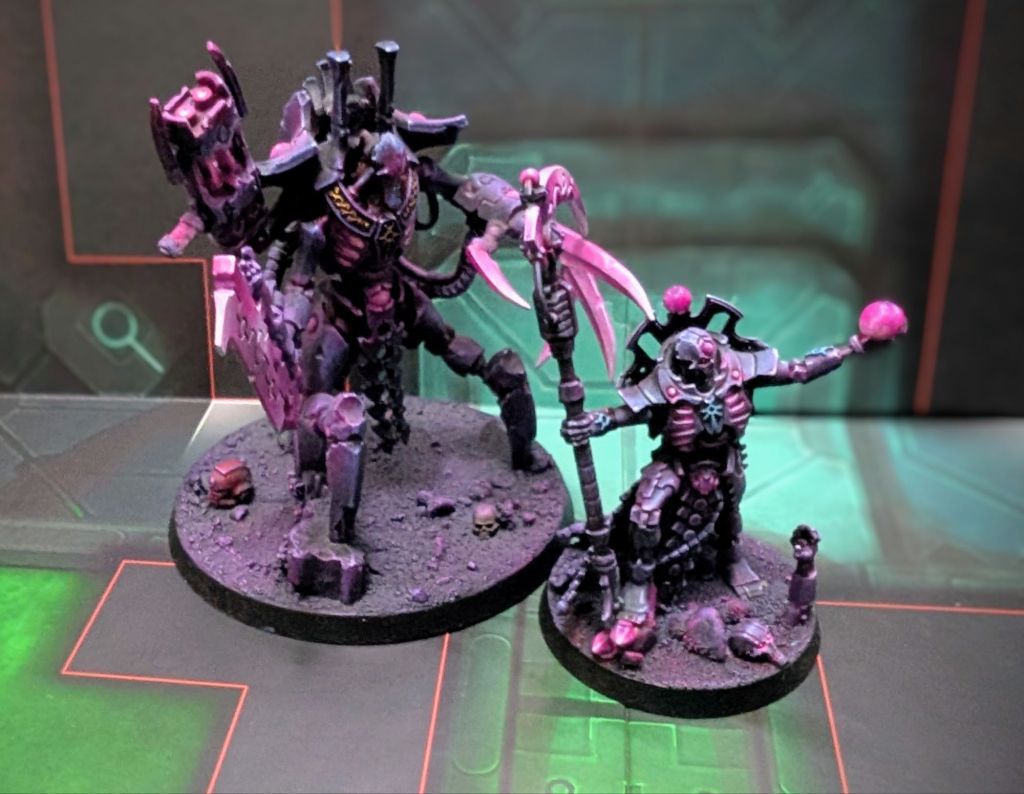
“But the Necrontyr were the most foolish of all,” he continued. “They thought that by prolonging life they could end their suffering. Instead they merely prolonged suffering itself. They created us, machines doomed to suffer eternally for their mistakes. Everlasting life isn’t the cure for suffering. Quite the opposite. Ergo, the cure for suffering is death.
“That is why I do what I do. I will put an end to suffering. I will kill every last thing in this galaxy, not out of malice, but out of mercy. When I am finished with the living, I will start on the dead, one by one until, at the very last I will cut down King Szarekh himself, for none but he deserve to suffer so much for what he has done to us.”
Farreskh still sat slumped on the ground. “I… think I understand…” she said.
“I hope so.” He stood back a little. “I would have you by my side, if you wish it. The regency is yours. I give it gladly. I… am a killer. That is my gift. It is the gift I can offer this galaxy. I used to think I could be something more, but I was not born to rule, as you are. You can lead this dynasty to glory in a way I never could. All I ask is that you join me in my mission. Let us endure the suffering together, until the final blade falls. Is that… what you want?”
“I want… I want…”
She looked up at him at last and her oculars blazed brightly, the thin coating of blood tinting them red.
“…I want to make this world bleed.”
 Victory Pointless
Leave a comment